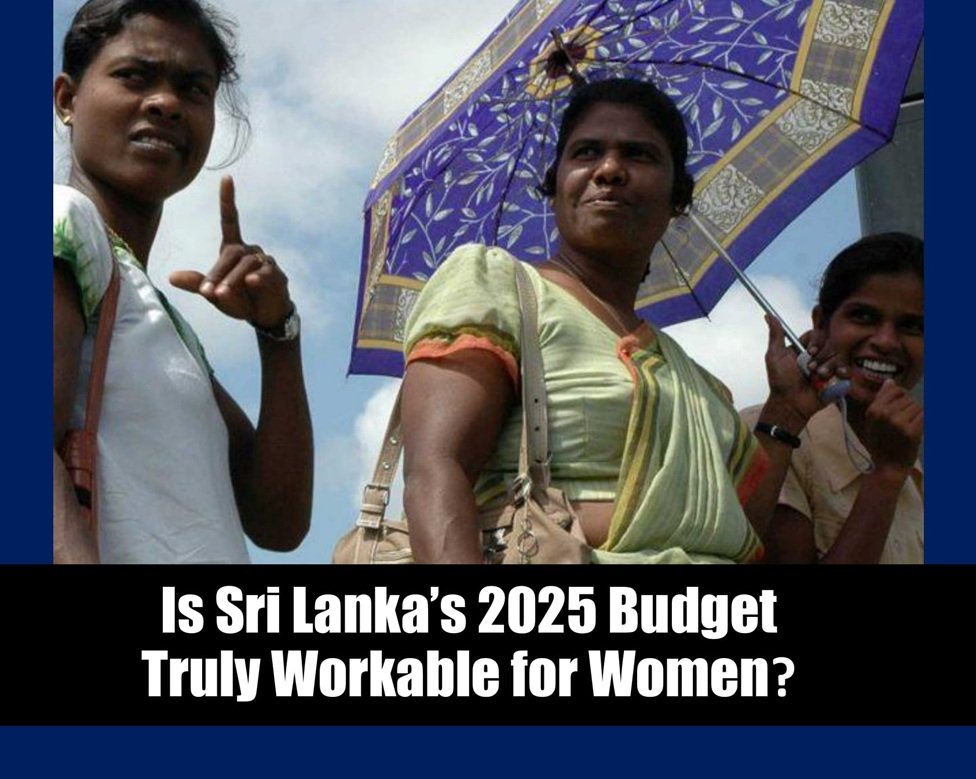
Is Sri Lanka’s 2025 Budget Truly Workable for Women?
- Editor
- March 6, 2025
- Current Issues, English Header
- current issues
- 0 Comments
Gayathri Nawarathna

“This budget is not just about economic reform—it is about justice, equality, collectivism, and humanity. It is a budget that transforms the country, ensuring that policies are not merely written into law but are actively implemented to create meaningful and lasting change.” – Dr Harini Amarasuriya(February 25, 2025at the Parliament)
The Sri Lankan government’s 2025 budget, introduced under a new administration with progressive ideologies, claims to prioritize gender equality and women’s empowerment. With gender-focused allocations, it outlines initiatives to improve women’s rights, economic participation, healthcare, and social welfare. However, a closer look raises doubts about whether these measures will deliver meaningful and sustainable change, or whether they are merely populist gestures crafted for political approval.
Dr. Harini Amarasuriya, a key figure in the budget discussions, emphasized that the budget’s goals are to ensure no one is left behind. “This budget addresses the needs of women, children, and all marginalized and oppressed groups, offering targeted measures for their welfare and advancement,” she said. While the sentiment is admirable, the budget’s provisions suggest that achieving lasting gender equality may be more complex than the numbers on paper suggest.
A major highlight of the 2025 budget is the LKR 45 billion allocated to the Ministry of Women and Child Affairs, representing a 12% increase from the previous year. This allocation signifies a growing recognition of gender equality in policymaking. Among the key provisions, LKR 10 billion is dedicated to women’s economic empowerment, primarily through microfinance, entrepreneurship grants, and skills development. While these measures could provide economic independence for some women, they are predominantly limited to low-paying, small-scale businesses. These opportunities fall short of integrating women into high-value sectors such as technology and engineering, which offer better long-term financial stability and growth.
Additionally, LKR 8 billion has been earmarked for maternal and reproductive healthcare, aiming to reduce maternal mortality rates and improve mental health support. However, Sri Lanka’s healthcare infrastructure, especially in rural areas, remains a significant challenge. The allocation of these funds may not be sufficient to meet the demand for essential services, leaving many women in underserved regions at risk. Moreover, LKR 5 billion is allocated to combat gender-based violence (GBV), funding shelters, legal aid, and awareness campaigns. While any investment in this area is critical, this figure is starkly lower than the LKR 15 billion allocated by regional peers such as Indonesia for the same cause.
The 2025 budget also includes LKR 12 billion for education and vocational training, with a particular focus on STEM (Science, Technology, Engineering, and Mathematics) fields. This is intended to address gender disparities in high-growth sectors. However, without comprehensive strategies to combat cultural biases and offer mentorship, women’s participation in STEM will likely remain low. Furthermore, LKR 10 billion has been allocated for social welfare programs targeting single mothers, widows, and elderly women. While this is an important provision, it may not be enough given the increasing economic hardships faced by many women across the country.
In a significant and timely step to support girls’ health and ensure uninterrupted access to education, the government has also allocated LKR 1.4 billion to provide sanitary napkins to schoolgirls. Although this was not highlighted in the budget speech, NPP MP Dr. Kaushalya Ariyaratne has called attention to it as an important intervention. Ensuring access to menstrual hygiene products is essential for reducing absenteeism among schoolgirls, contributing to gender equity in education.
Despite these positive developments, Sri Lanka’s gender-focused budget lags behind countries with similar Human Development Index (HDI) rankings, such as Thailand, Indonesia, and the Philippines. Thailand has allocated LKR 75 billion toward social security and gender-responsive policies that ensure women can enter high-income industries and leadership roles. In contrast, Sri Lanka’s focus on micro-enterprises limits women’s access to more robust economic opportunities. Indonesia has committed LKR 60 billion to gender mainstreaming, addressing the gender wage gap and workplace discrimination, whereas Sri Lanka has yet to introduce comparable policies. Meanwhile, the Philippines mandates gender-responsive budgeting across all government agencies, ensuring that at least 5% of government expenditures are directed toward gender equality—a practice Sri Lanka has yet to adopt.
While the budget includes some progressive allocations, it fails to address several critical issues affecting women’s empowerment. Unpaid care work remains a substantial burden for women in Sri Lanka, with many women spending disproportionate amounts of time on household labor, childcare, and eldercare. Unfortunately, the budget does not provide provisions for affordable childcare services, paid parental leave, or support for elderly care. In comparison, countries like Sweden and Canada compensate unpaid care work through subsidized childcare and paid family leave, recognizing its importance to both the economy and women’s well-being.
Although the budget promotes microfinance and entrepreneurship, it does little to encourage women’s entry into high-paying, high-growth sectors like technology, engineering, and manufacturing. The STEM workforce remains predominantly male, largely due to cultural biases and a lack of opportunities for women. There are no targeted scholarships or mentorship programs to increase women’s representation in these fields. In contrast, countries like Thailand and Indonesia have introduced gender quotas and financial incentives to integrate women into high-income industries, yet Sri Lanka has not adopted such approaches.
The issue of workplace discrimination and the gender pay gap remains largely unaddressed. While the budget aims to increase women’s economic participation, it lacks policies to eliminate wage disparities, ensure equal pay for equal work, and promote women to leadership positions. Countries like Indonesia and the Philippines have already enacted laws for equal pay and gender-responsive budgeting, but Sri Lanka has yet to take concrete steps in this direction.
Moreover, the budget’s allocation for gender-based violence (GBV) prevention, set at LKR 5 billion, is inadequate. This figure pales in comparison to Indonesia’s LKR 15 billion investment in similar programs. Given the rising instances of domestic violence, workplace harassment, and sexual abuse, greater investment in shelters, legal aid, and psychological support is essential. Without stricter laws and more substantial funding, survivors will continue to lack the protection and resources they need to rebuild their lives.
The budget also falls short in addressing rural women’s healthcare and reproductive rights. Rural hospitals suffer from a shortage of trained medical personnel and inadequate infrastructure, making access to maternal health services, contraception, and mental healthcare a significant challenge. Family planning services are underfunded, leaving women with limited access to reproductive education and services. Without a stronger commitment to expanding healthcare access in rural areas, many women will continue to suffer from preventable health issues.
Additionally, financial inclusion and land ownership rights remain key barriers to women’s empowerment. While microfinance programs are included, many women lack the collateral to access formal bank loans and are forced to rely on high-interest informal lenders. Inheritance laws often disadvantage women, making it more difficult for them to own property and build financial security. Without legal and financial reforms, true economic empowerment remains out of reach.
For the 2025 budget to have a meaningful impact, Sri Lanka must adopt gender-responsive budgeting (GRB) across all government sectors, similar to the Philippines’ approach, which allocates at least 5% of the government budget to gender equity. Recognizing and supporting unpaid care work through subsidized childcare, paid family leave, and elderly care programs is also crucial. Encouraging women’s participation in high-income industries through STEM scholarships, mentorship programs, and financial incentives for companies hiring women should be a priority. Additionally, enforcing equal pay laws, increasing funding for GBV prevention, strengthening workplace protections, and expanding rural healthcare access are necessary steps to achieve gender equity.
Although the 2025 Budget shows significant progress, its failure to address some of the key critical issues that hinder women’s development, such as unpaid care work, gender-based violence, and workplace discrimination, raises doubts about the government’s true commitment to women’s empowerment. “This is our first budget, and while there is still much work ahead, its importance lies in the clear direction it establishes. We have not only envisioned a prosperous and just society, but we have also set the foundation for making it a reality.” As Dr. Harini Amarasuriya emphasized to move beyond political experimentation, Sri Lanka must adopt a more structured and accountable approach to ensure that women’s empowerment is not just a budgetary allocation but a genuine policy commitment.

Gayathri Nawarathna