Challenges in the reconstruction of houses affected by Cyclone Dithwah
- Editor
- March 10, 2026
- English Header, Opinions
- opinion
- 0 Comments
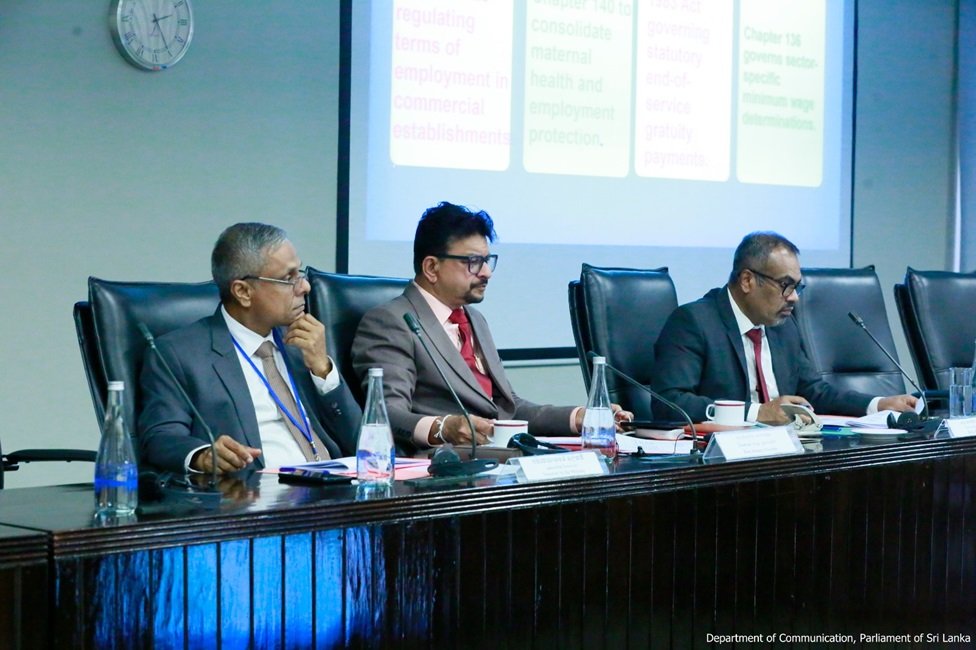
The 264th session of the ‘Kathikawa ‘ series of topical discussions organized every weekend by the National Movement for a Just Society was held on March 01 under the theme ‘Challenges in the reconstruction of houses affected by Cyclone Dithwah’. The resource persons for the discussion were the Vice President of the Tamil Progressive Alliance – Barath Arulsamy, Professor Rohan Samarajiva, and Sandhya Piyasena representing the Diriya Women’s Foundation, and the discussion was moderated by Harindra B. Dassanayake. This article has been compiled based on this discussion.

The fact that thousands of families are still displaced is a serious humanitarian issue – Prof. Rohan Samarajeeva
The Disaster Management Center (DMC) submits a Situation Report regarding Cyclone Dithwah daily and obtains information from the ground level (Grama Niladhari), so it can be considered a reliable report. According to the situation report issued by the DMC on March 01, 5933 houses have been completely destroyed due to the impact of Cyclone and the number of houses that were partially damaged was 1,15,501. As of March 01, 3146 people belonging to 1075 families are staying in 32 Safety Centers. Similarly, 149,927 people belonging to 43,831 families are staying with relatives, friends or in other locations, the Disaster Management Center stated in the situation report issued on March 01.
According to the DMC’s status report on March 01, the highest number of completely destroyed houses is in the Kandy district (1775 houses). 651 houses in the Puttalam district, 634 houses in the Kurunegala district, 587 houses in the Nuwara Eliya district, 549 houses in the Badulla district, etc., covering all 25 districts of the island, are reported to have completely destroyed houses.
The highest number of partially damaged houses is reported from the Colombo District (21,353 houses). 21,353 houses in Kandy, 12,737 houses in Kegalle, 10,037 houses in Gampaha, 9931 houses in Puttalam, etc. Partially damaged houses are reported covering 25 districts.
- Safety Centers
According to the DMC, as of March 01, the highest number of Safety Centers has been established in the Badulla District (16). There are 07 Safety Centers each in Nuwara Eliya and Kegalle Districts, and it is noteworthy that 02 Safety Centers are also operating in the Colombo District. The DMC says that there are 61 people belonging to 18 families in those 02 Safety Centers.
The largest number of families residing with relatives, friends or other places is represented by Nuwara Eliya District, with 60,691 individuals belonging to 17,833 families living in this way. In Kegalle District, 36,060 individuals belonging to 10,860 families, in Matale District, 23,083 individuals belonging to 6,670 families, in Badulla District, 21,473 individuals belonging to 5,880 families, and in Kandy District, 8,513 individuals belonging to 2,507 families live with relatives, friends, or in other places.
- A serious humanitarian issue
“When we analyze this data, it becomes clear that it is often the people associated with estates who are the most affected,” Prof. Samarajeeva pointed out.
He pointed out that the fact that 43,831 families have been living in shelters or other places other than their own for more than three months is a serious humanitarian problem.
“These 43,831 families are in a very precarious situation. They have not been able to return to their homes even after three months. There are also another 1075 families in government-maintained shelters. That means nearly 45,000 families are still displaced, unable to return to their homes even three months after Cyclone Dithwah. This is not a good situation at all, it is a serious humanitarian issue,” said Prof. Samarajeeva.
- What did they receive from the government?
The government provided an allowance of Rs. 25,000, Rs. 50,000, etc. to families affected by Cyclone to facilitate their return to their homes (to clean their houses). The media reported, citing the Ministry of Defence, that the Rs. 25,000 allowance had been given to over 98% of the families and the Rs. 50,000 allowance to over 75%.
Also, citing media reports, Prof. Samarajeeva pointed out that only 36.3% had received the government’s housing assistance to rent a house for those unable to move into their own homes by the end of February.
- Doubt about the data
Prof. Samarajeeva questioned the data contained in the status report issued daily by the DMC and expressed his disbelief in the data. He pointed out that the data, including the number of completely destroyed houses and partially damaged houses, did not match the data of relatives, friends, or people living in other places, and distorted the picture.
“This data takes the story to another place. According to the data of the DMC, as of March 01, there are 5933 houses that have been completely destroyed and 115,501 that have been partially damaged. Even if it is considered that 50% of the partially damaged houses are in a condition that makes it difficult to move back to, a total of about 60,000 houses are in a condition that needs to be rebuilt. But the problem is that more than three months have passed since the cyclone. If thousands of these families are still displaced after such a long time, it is a problematic situation. I believe that their entire family life has been destroyed. These individuals and families are facing several problems, including loss of their livelihood and disruption of their children’s education. These families are also facing several common facilities problems, including inadequate sanitation facilities. Prof. Samarajeeva emphasized that they have also had to live for many more months on the kindness and patience of another person or family,” adding that the government and relevant institutions should take immediate steps to resettle them.
He pointed out that according to the DMC’s reports, the government needs to build nearly 60,000 new houses, and also pointed out that the experience of the last tsunami disaster can provide ‘some insight’ into the time it takes to build new houses.
- More problems
Prof. Samarajeeva stated that although about 60,000 new houses should be built, this will create several other problems. Among them, he pointed out that the most serious problem and challenge is the difficulty in obtaining land for the relevant constructions.
He said that it is not possible to rebuild in landslide-hit areas and that infrastructure facilities such as roads, drinking water, electricity, etc. should be provided to resettle the people who had settled in those areas elsewhere. He also explained the difficulty in finding new lands in districts like Nuwara Eliya that have adequate infrastructure facilities.
“The idea that these people have been sheltering in shelters or other places for three months is that the government has not started construction of new houses. I assess that it will take at least two years to complete the construction of these houses. The other question that arises with this is where these families will live for a while. It is the responsibility of the government to provide the relevant infrastructure and sanitation facilities to these families,” Prof. Samarajeeva pointed out.
Prof., using international examples, showed that the government has the ability to construct ‘intermediate housing or temporary housing’.
- The dilemma of building houses
Prof. Samarajeeva made a lengthy analysis of the financial cost that the government will have to bear in constructing at least 60,000 new houses. Pointing out that there is a huge tariff pressure on all raw materials, including cement, used in the construction of houses, Prof. Samarajeeva also noted that this has led to an unsustainable increase in construction costs.
“With the resources we have, a large amount of raw materials is required to build at least 60,000 new houses and renovate another 60,000 houses. The question is whether to levy taxes on imported raw materials or on local products when rebuilding or renovating houses destroyed by Cyclone Dithwah. If various taxes, such as customs duties and VAT, are imposed in some way, the construction or renovation of these houses will become an extremely costly task. Overall, the government earns about 38% of its tax revenue by imposing taxes on imports. Accordingly, the government should take a clear policy decision on whether to levy taxes on the relevant construction materials when rebuilding or renovating houses destroyed by the cyclone. The reason for this is that the government is spending money earned locally on the reconstruction of these houses. Money earned from taxes,” Prof. Samarajeeva further explained his argument.
- What should be done?
Explaining his position on the reconstruction of houses destroyed by Cyclone Dithwah, the professor pointed out that the resettlement of displaced people is a primary responsibility of the government and that the government is obligated to resettle them.
“This is a big issue, an issue that should not be forgotten,” the professor emphasized.
He pointed out that the establishment of a task force for the reconstruction of these houses would be the most appropriate step. He also questioned the imposition of taxes on building materials imported for the reconstruction of houses destroyed by the cyclone.

The government does not want to provide a sustainable solution to the problems of the Malayagam Community – Bharat Arulsamy
Cyclone Dithwah hit the plantation workers and plantation-related communities in the central highlands the hardest. A large number of deaths were reported in these communities, particularly due to landslides, and the majority of houses that were completely or partially destroyed belonged to the plantation community. A significant number of these communities are currently living in shelters or with relatives, friends, or other places.
The government is not paying enough attention to providing housing or resettling this community, and there is a perception among the Malayagam Community that they have been ‘cheated’.
- Disasters and the Malayagam Community
“Even though it has been three months since Cyclone Dithwah hit, the government does not have accurate data on the loss of lives, disappearances, damage to houses and property, and economic losses suffered by the Malayagam Community. However, according to the data we have collected from the ground level, 4113 families belonging to the Malayagam Community have been directly affected. 73 people belonging to the Malayagam community have died. According to this data, it is clear to us that the Malayagam Community has been the most affected by Cyclone Dithwah.” Bharat Arulsamy pointed out that natural disasters, especially landslides, are not a new experience for the mountainous upcountry region. Bharat Arulsamy said that several families, especially Malayagam families, are affected by landslides in the mountainous upcountry region every year during the monsoon season, and a large number of families are displaced.
Bharat Arulsamy, who alleged that the Malagayam community did not receive adequate services from government institutions, including DMC, whenever they were displaced, stated that there had been no significant change in the situation even under the current government.
“They talk about it a lot when a natural disaster happens, but nothing happens after that,” he said.
He explained that the government did not provide adequate guidance and support to prevent natural disasters, cope with disasters, and restore life after disasters.
“I make this statement with great responsibility,” Arulsamy said.
- Horrible situation
Arulsamy said that even though the government has assured that people will not be resettled in landslide-prone areas and risk zones after the disaster, people who were living in those areas are being forced to resettle or relocate to those risk areas.
“This is a serious situation. The government promised that people in the risk zones would not be resettled. The government assured them that alternative lands would be provided. But now all those promises have been broken. Government officials have informed the people to return to their places of residence. In some cases, they are forcing them,” said Arulsamy, adding that the people in Colombo are not aware of this situation and that what is happening on the ground is very different from what they know.
“This is happening in my electorate. The authorities are pressuring the people to move back to the same places where the landslides occurred,” Arul reiterated.
Bharat Arulsamy revealed that the authorities have promised to provide a monthly house rent of Rs. 25,000 to the people who are moving in this way, and that the authorities have informed the affected people to receive this amount and resettle in the relevant houses.
“The entire village has been displaced. How will they find other places? Where will they get houses on rent? We need to look at this issue humanely,” Arulsamy said.
- Living like animals
Arulsamy alleged that the Malayagam community living in the most affected districts, including Nuwara Eliya, Kandy, and Badulla, were living in ‘a lot of animals’ in temporary housing devoid of even basic amenities, and also stated that the government had appointed a task force to find solutions to this problem.
“Unfortunately, this task force has not come up with a solution to this problem to date. Also, a significant number of Malayagam people have not received the Rs. 25,000 provided by the government to clean the damaged houses during the resettlement process,” Arul pointed out, revealing another serious problem facing the Malayagam people.
“The officials asked us for the land title deed to pay the Rs. 05 million compensation. This is a serious situation. The majority of our people do not have the right to the land they reside on; they do not have the title deed. If the government does not give us the title deed to the land, where will we get a title deed?” Arul questioned.
Bharat Arulsamy explained that the Malayagam community, who were affected by the cyclone, are facing several problems and added that he has submitted a written notice to President Anura Kumara Dissanayake regarding these problems.
“Our party leader, Mano Ganesan, has written to the President about these issues. He has requested the President to convene a meeting with all parties to discuss these issues. Unfortunately, there is no response to this to date,” said Bharat Arulsamy, explaining the challenges currently faced by the Malayagam community, who were affected by Cyclone Dithwah.

Nothing has happened as promised – Sandhya Piyasena
Most people know about the devastation caused by Cyclone Dithwah only through the media or through social media. The massive destruction was the headline in newspapers and was limited to a few seconds on television. But someone who actually witnessed this disaster would think, ‘It’s a miracle we’re alive.’ Although society is gradually forgetting this disaster now, it is a disaster that those who faced it and became victims will never forget.
“No one has any concrete information or data yet. We are still investigating what happened,” said Sandhya Piyasena, joining the discussion. A member of the Diriya Women’s Foundation, she witnessed the devastation and worked to help the affected people.
Sandhya said that even though it has been more than three months since Cyclone Dithwah, a significant number of people are still living in shelters or elsewhere. She further explained the pitiful situation that citizens who once lived independently and with dignity now face as orphans.
She pointed out that it has become difficult to benefit from crops on lands affected by landslides. She said that many houses have only one part affected by landslides and the other part has survived, and that families facing such situations are even more helpless.
“Many people are now gradually forgetting the situation. Therefore, the affected people have to rely only on themselves,” she said, explaining the challenges currently faced by the people affected by the cyclone.
“I think nothing has happened as much as it was said. Although aid has been received from many parts of the world, that aid has not reached the people properly,” said Sandhya Piyasena, based on her own experience.
We have not received a single rupee from the government – Fatima Rigana
Fatima Rijana, a victim of the landslides caused by Cyclone Dithwah, said that the government had promised to provide assistance and support to the displaced, including rehabilitation, to help them resume their normal lives. However, she revealed that she had not received any relief or assistance so far.
“Our house was hit by a landslide. Then we went to a camp. After receiving the reports from the National Building Research Organization (NBRO), the government said, ‘Don’t stay in the camps, immediately move to a rented house, we will pay six months’ rent at once.’ Hearing that, we went to a rented house. At that time, the government told us that they would give us Rs. 50 million to build a house, Rs. 50 million to buy a piece of land, and that they would give Rs. 25,000 to children who are studying. Later, it became Rs. 15,000. They said they would give Rs. 25,000 to clean the houses. They made us sign documents for all of that. We went to a rented house on January 02. Today is March 01. Till today, we have not received a single rupee from the government. There has been no response to the letters we have received. Even our lands have been completely destroyed by landslides. Only on two occasions have we been given a living allowance. After that, there is nothing. Today, we have no source of income,” said Fatima, explaining the situation her family is facing.