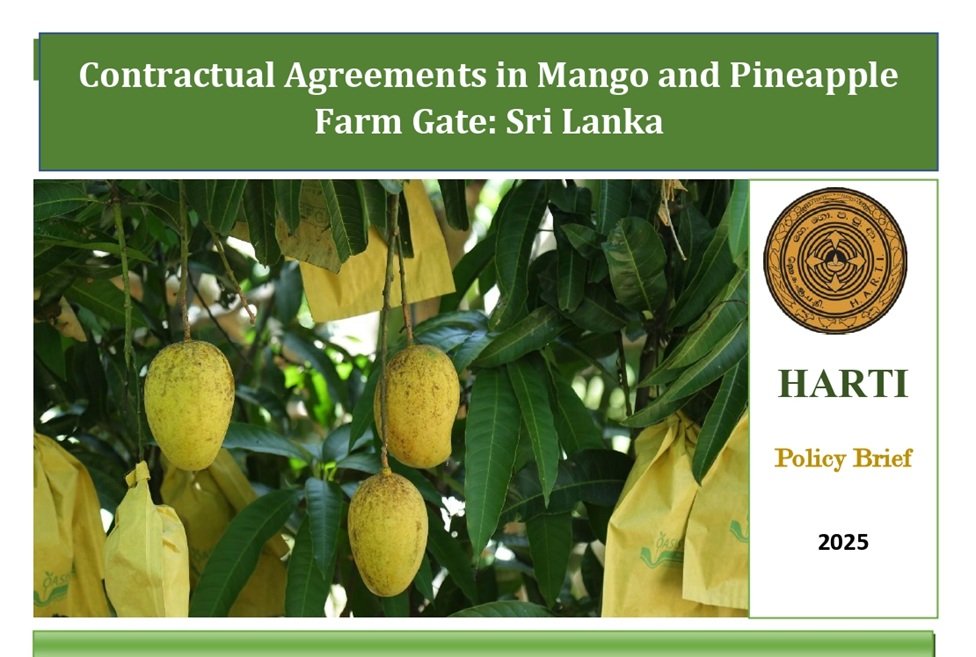
Contractual Agreements in Mango and Pineapple Farm Gate: Sri Lanka
Background
Producing and selling on a contractual basis is a common arrangement in agriculture all around the world. Contract can link farmers to a value chain and offer technical assistance, deliver inputs on credit, and reduce market risk, solving a number of constraints that limit small-farm productivity and income.
Increased market margins have been a serious problem to producers as well as consumers. Some of the practices that have reduced this scenario include contract farming and contract marketing. Though many have engaged in contracts, due to poor legal provisions and other factors, both producers and collectors have violated the contracts. Hence, research is needed to identify constraints to this system and provisions that are required to make contractual agreements in agriculture a success.
The objectives of this study were to evaluate agriculture contractual agreements prevailing in the Mango and Pineapple farm gate of Sri Lanka and identify the characteristics of contractual agreements to suggest policy measures to enhance the market linkages.
Methodology
An island-wide primary data was collected from 396 Mango producers and 108 Pineapple producers in Sri Lanka using a multistage stratified random sampling technique. Aggregate self-reported method: S-method1 and Visual Scale method[1] was used to rapidly estimate quantity loss.
The potential effects of participating in a contract, estimated using the propensity scores matching technique and ANOVA. The key informant interviews were conducted with leading fruit entrepreneurs to identify the contractual conflicts.
Findings
- “TJC” represents the predominant mango variety with 36.4%, followed by Karthacolomban at 38.4% and a smaller percentage, constituting 8.3%, allocated to “Villard” and other varieties includes 16.9 percent and consist with many varieties as Velleicolomban, Ambalavi, Kohu Amba, Malwana, Giraamba, Alfonso, Rata Amba, Papol Amba, Pol Amba, Wal Amba, Walu Amba, Apple Amba.
Table 1: Characteristics of Mango and Pineapple cultivation and income
| Mango | Pineapple | |
| Income above 50% | 8.8% | 86.1% |
| Commercial cultivation | 42% | 99% |
Source: HARTI survey data, 2024
- In Sri Lanka, mainly informal model and intermediary model contracts are observed,
Informal model: Individual entrepreneurs or collectors contracting informally with farmers on a seasonal basis
Intermediary model: A processor or major trader in fruit exporters or supermarkets formally or informally contracts with collector (or middleman) who then informally contracts with many farmers.
- Notably, only 0.5% of farmers have formal written contracts, while a majority (99.5%) relies on oral, informal contracts in Mango Cultivation. Same trend can be seen in Pineapple cultivation as well, where oral contracts predominate (99%). These contracts are performed under mutually convenient terms and conditions by buyers and producers. The oral contracts can be divided into four typologies as tree-based, fruit-based, weight-based, and volume-based in the mango farmgate, while in the pineapple farmgate, contracts can be divided as land-based, fruit-based, and weight-based.
- The ANOVA test indicates that there is no significant difference in loss or price received by the producer among contract types in both the mango and pineapple farmgate.
- The majority (82%) of the contract types do not mention the measures on unavoidable harvest loss, harvesting quality, contractual dispute settlement during the fruit harvest or pre-harvest.
- Commercial farmers and those growing high-demand varieties, such as TJC, are more likely to enter into contractual agreements.
- The PSM analysis showed that contract and non-contract farmers were largely comparable in terms of socio-demographic and farming characteristics. Still, it differed significantly in land size and proximity to market, two structural factors that may influence access to contracts and market power.
- These findings suggest that current contract farming models do not offer meaningful advantages for most smallholder farmers and fail to address key inefficiencies or vulnerabilities in the value chain. The informal nature of agreements, limited farmer bargaining power, price volatility, and absence of institutional safeguards restrict the effectiveness of contract agreements as a development tool
- The success of contract agreements in Sri Lanka’s fruit sector is highly contingent on contract design, enforcement mechanisms, and institutional support.
- Models that integrate public–private partnerships, formal written agreements, and accountability mechanisms offer more sustainable outcomes.
Why do contractual conflicts occur?
The majority of the informal verbal contracts are trust-based. The written contracts are characterized by loose legal bindings and lesser emphasis on contractual obligations of both the buyer and the producer. The main reasons for contractual conflicts include,
- Side selling by the producers
- Uncertainty about selling quantities and quality parameters
- More frequent price fluctuations
- Small scale cultivation and non- commercial orientation of cultivations
- Less awareness and reluctance for contractual agreements created contractual conflicts
Around three third of the growers expect government full support and cooperation (36.1%) and substantial support on the regulatory framework, infrastructure development (28.3%) on contract farming.
Recommendations
- Wider Government Interventions: Sri Lanka characterized an informal model contract type that emphasizes that the success of the informal initiative depends on the availability of supporting services, which, in most cases, are likely to be provided by government agencies. Therefore, wider government intervention is recommended.
- Promote Legally Enforceable and Transparent Contractual Agreements: Encourage Contracts defining quality standards through specific, measurable indicators and attach supporting documentation. Replacing existing informal contracts with formal agreements that clearly outline the roles, responsibilities, and legal obligations of both parties.
- Real-time Information: Develop the existing mango and pineapple value chains with a digital market platform that consists of real-time price data, having better contracts that are formal and emphasize responsible contractual agreements, product quality, pricing mechanisms, force majeure, and dispute resolution
- Address Value Chain Constraints Beyond the Contract: Those include improving access to market information, supporting reliable access to inputs and services, and developing rural infrastructure.
- Despite their potential, contracts often fail to deliver meaningful improvements in income or risk reduction due to inadequate design and a lack of support mechanisms. By aligning contractual practices with international guidelines and strengthening institutional support, Sri Lanka can foster more resilient and efficient agricultural value chains in the mango and pineapple sectors.
Research Team:
Dilini Perera, Sangeeth Fernando, Anupa Dissanayake, Raveena Udari
Hector Kobbekaduwa Agrarian Research and Training Institute