What is El Niño effect and how to prepare for its damaging effects
- Editor
- August 5, 2026
- Current Issues, English Header
- current issues
- 0 Comments
Emeritus Professor I M Dharmadasa and Journalist Saroj Pathirana
What is El Niño Effect
In a normal year steady winds flow from east to west as shown in the figure below and known as trade winds or equatorial winds. The main reason for this wind is the pressure difference due to the differences in temperatures in different parts of the globe. There is another reason called Coriolis force due to the spin of the globe. Due to these reasons, the trade winds blow mainly from the northeast in the Northern Hemisphere and from the southeast in the Southern Hemisphere. These predictable winds have been used by sailing ships to cross the world’s oceans in the past, and hence the name, trade winds. The sea water closer to the equator become warm due to the direct reach of the sun’s radiation, and this warm water follows the surface wind moving from the east to the west (see figure 1).
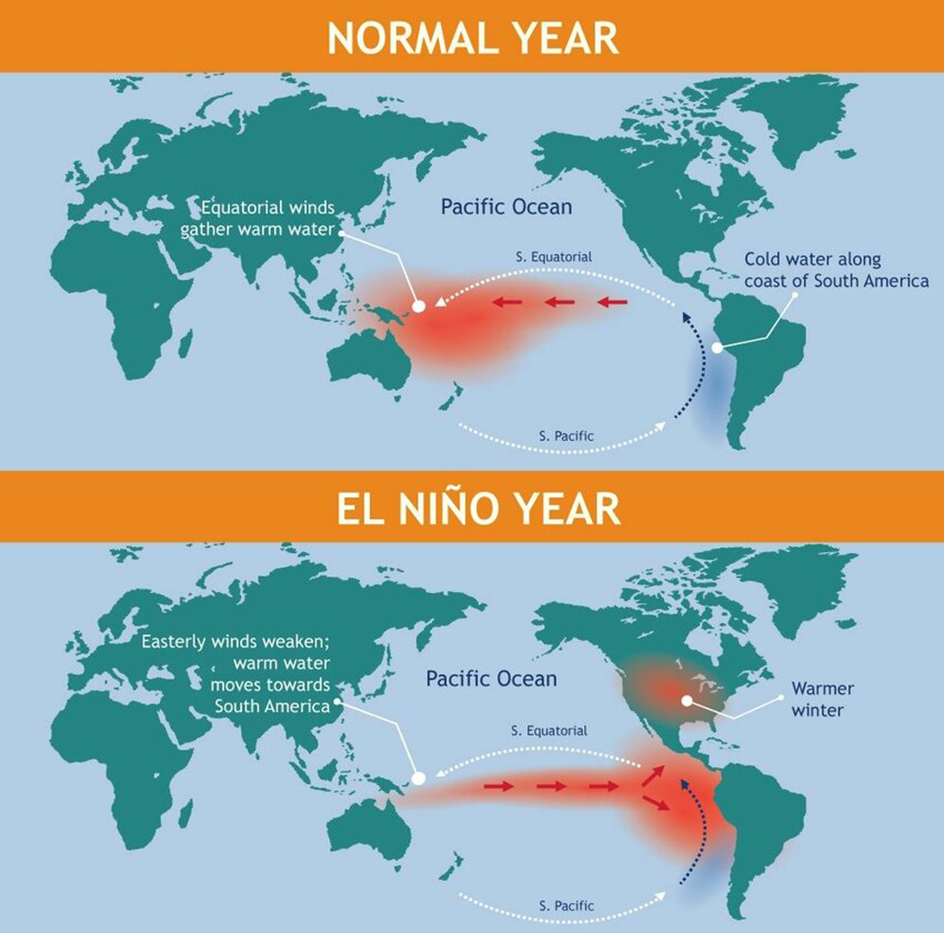
In this discussion we consider the main changes occurring in the Pacific Ocean, the largest ocean which covers more than 30% of the planet’s surface. Under normal conditions, strong trade winds blow from east to west across the equatorial Pacific Ocean, pushing warm surface water toward Southeast Asia and Australia. This movement allows cold, nutrient-rich water to reach along the western coast of South America, supporting marine life and stabilizing predictable regional climate patterns. Warm water close to Australia creates more rain due to increased water vapour in the atmosphere, in this region while the south American region experiences dry weather.
However, El Niño is identified when sea surface temperatures in the Pacific Ocean closer to Australia rise at least 0.5°C above average for several consecutive months. This warming alters the atmospheric circulation due to Ocean-Atmosphere interaction, and the trade winds weaken or reverse, causing warm surface water to drift back toward the American continent. This eastward displacement of warm water creates a large pool of unusually warm water in the eastern Pacific Ocean. Warm water releases more heat and water vapour to the atmosphere causing heavy rainfalls in America and droughts in the south Asia and Australia changing the normal weather patterns. These changes are highly unpredictable and varies from place to place.
El Niño and La Nina effects typically occurs every two to seven years and last nine to twelve months. During an El Niño event, global temperature increases, while during a La Nina event, temperature falls. La Nina is caused by unusually cold Ocean temperature in the equatorial Pacific. Both these events occur regularly with slight variations of the time periods.
Figure 1. The direction of warm water flow in the Pacific Ocean during a normal year and during an El Niño year.
Damaging effects of El Niño Event
El Niño due to warmer ocean temperatures and changes in the pacific jet streams, can create severe weather disruptions changing the normal weather patterns. These include heavy rains, tropical cyclones, hurricanes, floods, and soaring global temperature causing extreme droughts.
Above description was mainly limited to changes in the Pacific Ocean. However, when it comes to Sri Lanka, changes in the 3rd largest Indian Ocean known as Indian Ocean Dipole (IOD) and monsoons also contribute to weather patterns. Release of heat from the warm water pool in the Pacific Ocean could affect far away places like Europe creating dry conditions causing forest fires. Current El Niño started during June/July of this year, and Sri Lanka could experience the resultant effects of El Niño, IOD and the monsoons.
How to prepare for expected damaging effects
Once the dangers are identified, it is possible to prepare at least for some events. Both wet and dry weather conditions affect the most important clean drinking water and food production. Therefore, the country should take every effort to safeguard clean water sources and avoid food scarcity during these periods.
Peoples’ accommodation must withstand during cyclones and hurricanes, and every new dwelling must be built with required strength and high quality. A reliable weather forecasting is helpful in warning the citizens to take appropriate precautions and especially to warn fishermen in the country to safeguard their lives. Accurate weather forecasting could also help farmers in the country in food production.
Specially during the dry seasons, water management is crucial. To survive during severe droughts, old wells should be cleaned and repaired to provide clean drinking water, especially in rural villages. Tree planting helps in safeguarding the ground water, and rainwater harvesting should be encouraged. Livestock stress is common during this period reducing animal growth and milk yields. Every effort must be taken to avoid forest fires during the dry periods. Forest fires occur due to natural events like lightning and heat created by friction due to two tree branches moving while touching with each other. Human carelessness like making bonfires also a major reason. Instead of burning plenty of dry leaves, these should be used to make useful compost for food production. Burning leaves exacerbate climate-change effects by adding more carbon dioxide into the atmosphere.
People need to use both electricity and water carefully especially during these difficult periods for our survival.
About the Authors
I M Dharmadasa: is an Engineering Scientist who retired recently after serving 51 years in four universities (Peradeniya, Durham, Cardiff and Sheffield Hallam). He has also worked in British Petroleum Research on a solar panel commercialisation programme based on electroplated CdTe thin films. As an Emeritus Professor, he is contributing to research as an Editor of JMSE (Journal of Material Science; Materials for Electronics), advice governments on clean energy technologies and focus on community development projects – solar villages. He is the chairman of the recently formed solarvillagesdg community interest company.
Saroj Pathirana: is an OCCRP Fellow and freelance journalist covering Sri Lankan current affairs for international media. He spent more than 25 years with the BBC and is the founder of the YouTube channel Sandeshaya by Saroj. His investigative work includes an in-depth investigation into the X-Press Pearl maritime disaster as a Fellow of the Pulitzer Center’s Ocean Reporting Network.