EXPLAINER – PROTECTION OF THE STATE FROM TERRORISM BILL (PSTA) 2026
- Editor
- September 30, 2026
- English Header, Political
- Political
- 0 Comments
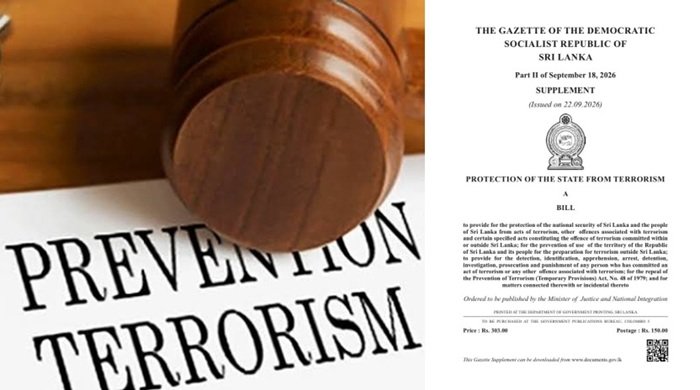
The PSTA was published in the Gazette on 22nd September 2026.

What is the scope of the Bill?
- The proposed law repeals and replaces the Prevention of Terrorism Act No. 48 of 1979. It sets out the offences, the manner for trial and penalty, and expands powers of arrest, search, detention and investigation beyond police officers to armed forces and coast guard. The proposed law will apply to anyone who commits ‘an offence’ under the Act, whether inside or outside Sri Lanka (Cl. 2).
What are the Offences of Terrorism in the PSTA?
- The Bill describes terrorism as
- any act, which causes the consequence of death, damage to public property, long-term detriment to environment, serious risk to the health and safety of the public, interference or damage to any any computer system, electronic, wired or wireless systems, destruction of tangible cultural property,
- with the intention or knowledge that those acts will provoke terror or compel a government or an organisation to do or not do any act, to advance a political or ideological objective. (Cl. 3)
- The proposed law says that protest, advocacy, dissent, strikes and industrial action as well as humanitarian and medical activities will be excluded from treatment as offences. (Cl. 3(4))
This definition lacks the recommended international standard that an act of terrorism must require the offender had an intention to commit death, serious bodily injury or kidnapping. In practice, the exception provided for protests etc is unlikely to be considered by an arresting officer and will have to be later proved before a court, most likely in a fundamental rights application before the Supreme Court – which is an expensive process, limited by a 30 day window to file an application and hindered by geographic access.
Previous judgments of the Supreme Court do not show a trend of strong protection of fundamental rights in terrorism related cases.
Other offences under the Bill (which makes the above broad definition, even wider)
| Attempts | Attempting, aiding, conspiring or any preparatory act to an offence is an offence. (Cl. 5) |
| Proscribed organisations | Joining, recruiting for, funding, giving material support to or helping the activities of a banned organisation is an offence. (Cl. 6) |
| Specified acts | Certain offences under the Assistance to and Protection of Victims of Crime and Witnesses Act, or possessing an item to commit / attempt to commit an offence is an offence. (Cl. 7) |
| Associated acts | Interfering with the identification, arrest, custody or detention of a person who has committed an offence; or collecting or passing on confidential information knowing it will be used by another person to commit an offence, are offences (Cl. 8) |
| Speech and publications | Inducing the public to commit an offence, directly or indirectly, through words, signs or publications, and disseminating “terrorist publications”. The Bill defines ‘terrorist publication” as a publication directly or indirectly inducing an act of terrorism or material that is useful in the commission of terrorism. The Bill exempts material published in good faith for a public purpose. (Cl. 9-10) |
| Training | Giving or receiving training in firearms, explosives or any method of committing terrorism. (Cl. 12) |
| Failing to report or helping someone hide | Not giving information about an offence or attempt, hiding a person who has committed or is about to commit one or obstructing orders made under the Act. (Cl. 15) |
The Penalty: Life imprisonment for causing death and a maximum of twenty years of rigorous imprisonment and/or fine of Rs. 20 million for other acts of terrorism (under Cl. 3) and attempts (under Cl. 5 &Cl. 4). A maximum of fifteen years rigorous imprisonment / fine of Rs. 15 million for committing or attempting to commit other offences. (Cl. 13-14)
Who can Arrest and How?
- A police officer, member of the armed forces, or coast guard officer can stop and search a person they reasonably suspect has committed or is attempting to commit an offence. (Cl. 19-20)
- Any offence under this Act is a cognizable offence which means that an arrest does not require a warrant. (Cl.18)
- At arrest, the person must be told, in a language they understand, who is arresting them, why and that they can have a lawyer. (Cl. 21)
What happens immediately after arrest?
| Within 24 hours | If arrested by the armed forces or coast guard, they must hand the suspect to the nearest police station. The suspect’s family must be informed and a notice goes to the IGP, the Human Rights Commission (HRCSL) and the relevant commander. If a suspect is arrested by a police officer, he must be produced before the OIC of the police station immediately. (Cl.23, 24 & 25) |
| Within 48 hours | Once in police custody, a suspect must be produced before a Magistrate within 48 hours (Cl. 26(1)). The Magistrate may extend detention in police custody by a further 24 hours, and must check the suspect’s wellbeing privately, without the arresting officer present. (Cl. 26(2),(4),(5)) |
| Detention Order (DO) | Where there is a Detention Order, the suspect is to be produced before a Magistrate within 48 hours of the arrest and the Magistrate shall give effect to the DO (Cl. 26(3)(a)). The suspect is to be held at an approved place of detention. The suspect is to be given a copy of the DO within 48 hours. (Cl. 27(6)) |
About Detention Orders
Ordinarily, the police are not permitted to detain people. Only arrest and submit before a Magistrate. It is a judge who can make an order to detain a person in remand custody. A detention order, where the police can decide and detain a person for long periods within police custody, is an extraordinary power given in extremely high security situations. Detention means police custody, and remand refers to custody within the prison system which is under judicial supervision. The PSTA continues to permit detention orders.
First detention order
- A senior police officer (DIG or above) applies in writing to the Defence Secretary, who may issue a Detention Order for up to 2 months if he is satisfied there are reasonable grounds. (Cl. 27)
- A copy of the detention order to be submitted to the Magistrate and the suspect and next of kin. (Cl.27(6),(7))
- Detention must be at an approved place, gazetted by the President recommended by the IGP. (Cl. 32)
Extension of detention order
- The police may apply for an extension through the Attorney General to the High Court. The High Court may approve an extension beyond two months. The suspect or their lawyer has the opportunity to object to the extension.(Cl.28)
- The Human Rights Commission must be informed of any extension. (Cl. 28(5)) Detention orders for suspects in remand while investigations are on
- If a suspect is in remand, on an application by the Attorney-General, the High Court may permit detention (removal into police custody) in 2-week periods, up to 6 months in total. Upon the conclusion of investigations or after six months, the suspect is to be sent back to remand custody. (Cl. 39)
Detention orders after investigation is concluded and trial commences
- After indictment (commencement of trial), if the Defense Secretary thinks that it is necessary to remove from prison custody and take into police custody the person accused of an offence, he may through the Attorney General make an application to the High Court, and the Court may issue a Detention Order till the conclusion of the trial. (Cl. 54)
What is the maximum period of remand and detention?
A suspect may only be detained under a Detention Order for a maximum period of 1 year. (Cl.27) A suspect may only be remanded by a Magistrate for a maximum period of 1 year (Cl.29)
A suspect may be detained up to 1 year after investigations have concluded and indictment is served. (Cl.54) Therefore, if all of the above provisions are applied, a person may be detained up to a maximum period of detention and remand of three years. This may be longer if the detention is to continue till the end of the trial and the trial takes longer than a year.
Can a person be released on bail under the PSTA?
If the offence relates to causing death, no. Otherwise,
- a person remanded by a Magistrate without a Detention Order may be released on bail by the High Court if no indictment has been issued in one year of remand. (Cl. 29)
- Or a High Court Judge can release a suspect on bail after refusing to remand him or extend the Detention Order beyond two months (Cl. 28(4))
Can a person be discharged from the case under the PSTA?
- At the end of an investigation, if there are no allegations of a crime in the police report, the Magistrate has power to discharge a suspect. (Cl. 37(3))
- At any time after arrest and before the end of investigations, with the consent of the Attorney General, a Magistrate may discharge a suspect. (Cl. 37(3), proviso)
What is the role of the Magistrate under the PSTA?
- The Magistrate must give effect to Detention Orders or order persons to be remanded for investigation. They cannot refuse to do so. (Cl. 26
- The Magistrate must visit the approved place of detention every month, without notice and interview detainees. (Cl. 33)
- If the Magistrate suspects torture, degrading treatment or cruelty, they must direct the detainee to be produced before a Judicial Medical Officer and to be medically treated. If the medical report says torture is probable, Magistrate must make an order to change the place of detention. (Cl. 31)
What extraordinary executive powers are found in the PSTA?
- Power to use force to stop vehicles, vessels and aircrafts from moving, take control over and suspend movement. (Cl. 45, 46 & 47)
- Police officers can require suspects to submit affidavits and other documents, after obtaining a Magistrate’s court order. (Cl. 44)
- Directions by any police officer to the public if they believe there is clear and present danger, to order vehicles to stop moving, to not hold rallies, meetings, processions and to stop any specified activity. The police can seek approval from the court within 24 hours. (Cl.51) If anyone disobeys any
direction, they may have to pay a fine of up to one million rupees or may be imprisoned for up to one year or both.
- Restriction Orders (restricting travel, access to places, communication and association of persons or entities, requiring to report to a police station as required and other necessary limitations) can be applied for by a DIG and issued by a Magistrate, valid for three months. These Orders can be reviewed by the High Court or the Court of Appeal. (Cl. 60-62)
- Proscription Orders can be issued by the President to ban organisations and any activity related to them and will remain valid until rescinded. These orders can be challenged in the Court of Appeal. (Cl.59)Orders relating to Prohibited Places can be issued by the Defense Secretary prohibiting access to any location for 72 hours if he has reasons to believe that the place may be used to commit or prepare to commit an offence. (Cl. 61)The police may obtain assistance from the armed forces/ coast guard for investigations. (Cl. 42 & 43)The Attorney General may defer or suspend criminal prosecution on the condition that the suspect agrees to making a public apology, paying reparations, or commits to undertake community/social services. (Cl. 52 & 53)
- The President may issue directions he thinks is necessary to give effect to this law. (Cl. 69)
Commentary
The PSTA is a more dangerous law for civil liberties than the PTA it replaces. The procedural safeguards that have been added to the PSTA, which are absent in the PTA, fail to practically protect a person from arbitrary arrest or lengthy detention or remand, nor does it compensate a person for any loss suffered. The PSTA also includes new extraordinary executive powers that were not available under the PTA. In terms of extraordinary executive power, the PTA only empowered the Minister of Defence to make restriction orders (Sec 11) and to prohibit publications (Sec 14) (which was repealed in 2022).
PSTA legalizes some of the abuses carried out under PTA. By broadening the definition of offences, legalizing detention in police custody while investigations are being carried out and even during trial, compelling affidavits, clearing citizens from congregating, holding rallies etc, the PSTA legalizes repressive actions that did not have legality under the PTA.
The PSTA is a minimally amended version of the previously criticised Wickremasinge – Rajapakse anti terror laws. In substance and tone, the PSTA follows the Anti Terrorism Bills gazetted by then President Ranil Wickremasinghe and the SLPP government in 2023, which was essentially an anti-aragalaya law that targeted citizen protest and dissent. With its overly broad definition of what constitutes an offence, this law empowers the police to clear citizens from congregating, holding rallies, processions, having meetings and gives the President the power to proscribe organizations indefinitely.
NPP betrays their commitment to repeal PTA by attempting to replace the PTA with an even worse law. Having promised in their election manifesto to repeal the PTA and having long criticised the PTA and all oppressive laws, the NPP’s gazetting of the PSTA is essentially a complete reversal of this position.
The PSTA does not comply with international standards – in terms of definition, overbroad executive powers and lack of meaningful safeguards – legal aid, compensation for wrongful actions. As such Sri Lanka will fail to meet the country’s international commitments to the United Nations and the European Union.