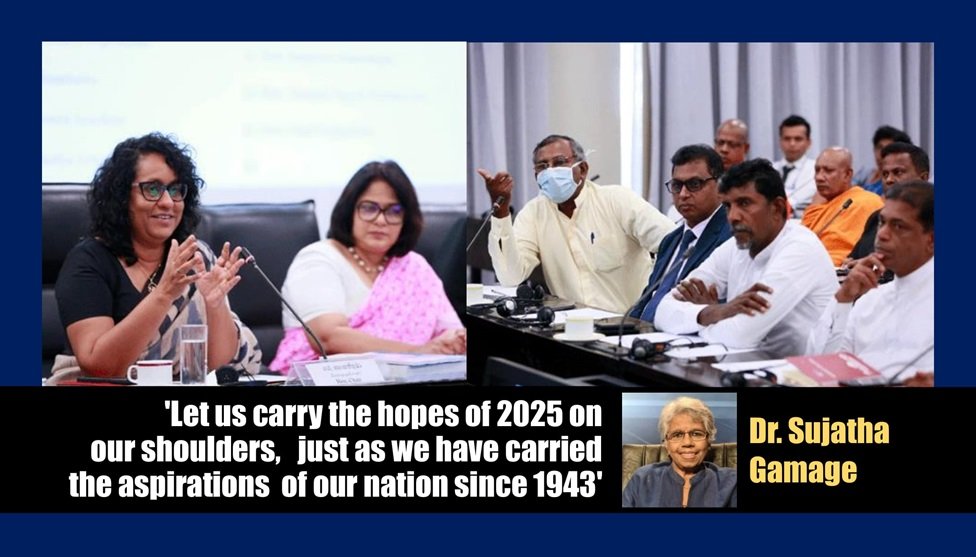
‘Let us carry the hopes of 2025 on our shoulders, just as we have carried the aspirations of our nation since 1943’ – Dr. Sujatha Gamage
- Editor
- August 1, 2025
- Current Issues, English Header
- current issues
- 0 Comments
Whether the core of the proposed educational curriculum reform timely and realistic?
The government has unveiled new proposals for education curriculum reform. Since their introduction, a wide range of parties — including both government and opposition — have weighed in, offering differing arguments, opinions, and suggestions. Amid this growing debate, President Anura Kumara Dissanayake was compelled to make a special statement addressing the issue. However, despite the President’s remarks, public interest in the matter remains high. This sustained attention is understandable: the proposed reforms impact every citizen, not just today but well into the future. As such, this is not a moment to be overlooked. Citizens, scholars, and all interested parties must recognize the significance of this moment and engage actively in shaping the direction of education in the country.
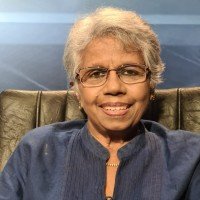
In this context, the National Movement for a Just Society held the 235th discourse in its ‘Debate’ dialogue series under the theme ‘Is the Core of the Proposed Education Curriculum Reform Timely? Realistic?’. Dr. Sujatha Gamage, Professor Chandragupta Thenuwara and retired Assistant Professor Yamuna Ratnayake participated as resource persons in this discourse, and the discourse was moderated by socio-political analyst Harindra B. Dassanayake. This article has been compiled based on this discourse.
The foundation for any meaningful discussion on the essence of the proposed education curriculum reform should be the PowerPoint presentation recently delivered in Parliament by the Prime Minister and Minister of Education, Ms. Harini Amarasuriya. However, this situation is far from ideal. In fact, it marks an unprecedented moment possibly the first time that such a significant policy proposal has been introduced primarily through a presentation of this kind.
“While the manner in which the Prime Minister presented this important proposal was less than appropriate, we are nonetheless pleased that such a proposal has been brought forward and that there is a stable government to lead its implementation,” Dr. Sujatha Gamage said, opening the discussion with both subtle criticism and praise for the government’s efforts.
“Educational reforms often resemble a wish list. No matter what curriculum is introduced, the success of these reforms ultimately depends on how effectively they are implemented in the classroom. I refer to this so-called ‘wish list’ because, in truth, that’s what it has been over the years,” Dr. Sujatha Gamage explained, sharing her perspective on the proposed education curriculum reforms. “As I began unpacking this wish list, I realized it’s something we’ve been carrying with us for a long time—since 1943. We set it down, pick it up again, and repeat the cycle. This has continued for decades.”
She emphasized the need for reflection and accountability, urging the government, civil society, and academia to examine what has—or hasn’t—happened over this prolonged period. She also noted that every new government shows an interest in educational reforms, yet continuity and follow-through remain persistent challenges.
“No government before us has carried out this task properly. Each new administration believes it is finally getting it right, and then tries to take ownership of the reforms, presenting them as entirely their own initiative,” said Dr. Sujatha Gamage. “This government, too, appears to be following that pattern. But we must make it clear that approach is misguided. The drive for educational reform is not the property of any one party or government; it is a collective aspiration, rooted in public demand. Therefore, it must be pursued as a shared, collaborative effort.”
Why reforms?
When examining the aims and objectives of the new education curriculum reforms, it appears to be multifaceted. But from a policy perspective, the important point is what problem is expected to be solved through these reforms?
When examining the aims and objectives of the new education curriculum reforms, it appears to be multifaceted. But from a policy perspective, the important point is what problem is expected to be solved through these reforms?
A response to the 71 uprising
In response to the 1971 uprising by the Janatha Vimukthi Peramuna, the then Sirimavo Bandaranaike government took steps to implement a more comprehensive education reform in 1972.
“Those guys looked into what we were doing in schools. They realized that most people were failing the O-level examination that was being held at that time. Even if they passed, they did not have jobs. The government also discovered another important fact, that although the majority of people in this country were engaged in agriculture, there was no room for it in school education. Accordingly, the government took steps to change the O-level examination. At that time, the important issue was the issue of the curriculum,” Dr. Sujatha pointed out, explaining the status of the 1972 education reforms. She further pointed out that the changes made in primary education in 1999 were more important.
The then President Chandrika Kumaratunga appointed a Presidential Task Force in 1997 and the report submitted by the Task Force focused heavily on ‘soft skills’. Explaining the path of education reforms, Dr. Sujatha also mentioned the education reforms that were undertaken during the Gotabaya Rajapaksa and Ranil Wickremesinghe regimes.
Revolving around the same issue
Dr. Sujatha pointed out that all the educational reforms implemented from 1943 to 2025 revolved around the same issue. Explaining this situation further, she also pointed out as follows.
“This is going to solve the same set of problems for more than eight decades. What happened to what we did in 1943? The secondary schools gradually declined due to lack of resources. The framework that was supposed to bring English education to the children declined, and the curriculum that provided practical knowledge gradually became more academic by 1970. The Ordinary Level Examination became more academic. There is a very important explanation in this regard in a book written by Mr. Eric Silva, a former secretary. Another important thing happened here. English language education disappeared from secondary schools and rural schools and was again limited to the urban schools of the English-speaking elite. By 1970, the program to provide English education to rural students had completely declined.”
How the middle class was hurt
This educational system was reformed by the Sirimavo Bandaranaike government that came to power in 1970. The government took steps to abolish the Ordinary Level Examination, which was later reformed. The government introduced another examination called the NCGE examination in place of the Ordinary Level Examination.
“Through this, although there were seven or eight subjects, two pre-vocational subjects were introduced for grades 6-9. I believe that this should be reflected in a national examination. Those who have experience with these two subjects speak positively about it. Although the NCGE examination related to these curriculum reforms was scheduled to be held in 1975-76, it failed due to great opposition. In my opinion, the two pre-vocational subjects were a big problem for the middle class. In 1977, the United National Party announced as an election promise that the NCGE examination would be abolished.” Pointing out that another important curriculum reform program had failed in this way, Dr. Sujatha Gamage also said that the aspirations of the oppressed classes of this country had to be put down again.
Tara D. Mel Reforms
Tara D. Mel, then Secretary of the Ministry of Education, played a key role in introducing the 1999 education reforms. These reforms brought about major changes in the primary curriculum and introduced activity-based, student-centered education.
“This curriculum really worked. I have studied this curriculum, it is a very good curriculum. Teachers were trained, all the necessary resources were provided and it was done. But soon these reforms became examination-centric, even primary education became examination-centric. The reason for this was the change in the 1997 scholarship examination, a question paper was added that measured subject knowledge. In the end, the 1999 education reforms also fell through. But in 2007, this concept was tried to be taken forward again through secondary education. There, an attempt was made to make a change in the examination system, instead of measuring opinion, other skills were tried to be measured. But that too could not be carried forward correctly. That bag of wishes had to be put down.” Here, Dr. Sujatha Gamage said that although we tried to take up this bag of wishes again in 2020 and 2023, we did not get the opportunity to do it properly.
Considering the journey from 1943 to 2025, what has been presented so far is a bag of wishes from all of us. This is something we have carried and brought for over eight decades. It is something that the National Institute of Education has been doing since 2019. Therefore, I think we should all move forward with a positive critique of this.
2025 Pathum Malla
What exactly is in the Pathum Malla that we are preparing to implement in 2025? The government claims it contains transformational change—and yes, there are indeed transformational elements. But if we are to bring about meaningful transformation, it must focus on one key question: What are the learning outcomes? As I see it, this reform effort does address that to some extent.
I believe that the current curriculum for Grades 1 to 5 should not undergo significant changes. There is still talk about the Grade 5 Scholarship Exam remaining in place—and that is true; it cannot be removed all at once. However, we are told that by Grade 9, there will be an exam that measures students’ literacy in mathematics and their mother tongue. I see this as a potential replacement for the Grade 5 Scholarship Exam, and I welcome this change. Why? Because we have always argued that the Scholarship Exam should not assess subject knowledge based purely on memorization. Instead, it should evaluate practical understanding.
From what I understand, these reforms are set to be implemented in 2029. I anticipate that a kind of benchmark or cut-off test will be introduced at Grade 9. There will be no major changes in Grades 6 to 9, meaning students will continue studying 14 subjects under the core subject system. Within this structure, a new module titled Further Education will be introduced. This module will allow students to choose subjects for either practical or theoretical study. While this may not seem like a drastic shift, it is a step forward. However, if the focus remains on textbook knowledge rather than practical understanding, we cannot claim true transformation.
I believe the most significant transformational change will occur in Grades 10 and 11, particularly in the A-Level examination system. At this point, Dr. Sujatha offered a detailed explanation of how the Ordinary Level (O-Level) exam is currently conducted, how marks are awarded, and the challenges within that system.
She highlighted that a major shift in the measurement of knowledge and skills will take place under the 2025 education curriculum reforms.
“We must remember that the results of these reforms will become visible in the O-Level examination by 2029. These students will then enter society around 2031. If these reforms are not implemented effectively, approximately two million young people will enter society in the coming years without the benefits of a revised education system. We must think carefully about that.”
Dr. Sujatha also emphasized that for curriculum reforms to succeed, five foundational pillars must be completed. She strongly argued that more focus should be placed on education administration rather than just curriculum design. She questioned the government’s intent to manage the entire school system centrally and stressed that the Ministry of Education itself must first be reformed. Most importantly, she insisted that the Ministry should operate strictly within its proper role.