The fight to decriminalise same-sex relationships in Sri Lanka
- Editor
- February 6, 2025
- English Header, Political
- Political
- 0 Comments
The history of LGBTIQA+ organising and activism in Sri Lanka contains many hard-won victories, but the target of undoing the colonial-era Sections 365 and 365A remains unrealised
At 21 years old, in 1999, Upeksha Thabrew was evicted from her house because her family found out about her sexuality. Thabrew’s family were traditional Sinhala Buddhists, with a conservative stance on LGBTIQA+ people. Such reactions are the norm in Sri Lanka, where same-sex relationships remain stigmatised and have yet to be decriminalised.
Members of the LGBTIQA+ community often have to lean on each other for support due to the threat of eviction from their homes, discrimination by society and insubstantial social protection. In Thabrew’s case, it was Sherman de Rose, a pioneering activist from the Sri Lankan queer community and the founder of Companion on a Journey (COJ), who helped her find a room to rent. While COJ, a queer support group founded in 1995, was one of the first spaces for queer activism in the country, it focused on working with people of masculine identities, such as homosexual men, bisexual men and nachchi – an indigenous queer identity. In 1999, a lesbian couple from Kalutara in southern Sri Lanka took their own lives because of the harassment and discrimination they faced from their families. This sparked debates within COJ about whether the group was equipped to support queer women.
“We started the Women’s Support Group (WSG) in 1999 with Companion on a Journey, as their women’s wing,” Thabrew, a co-founder of the WSG, told me. Thabrew is now 46 years old, based in New York and employed as a chef. She and a number of other activists set up WSG in COJ’s garage. The collective received mentorship from the feminist activist Sunila Abeysekera, whom they fondly called Sunila akka – “big sister”. The WSG had an intersectional stance and supported lesbians, bisexuals, intersex people and transgender men. “I realised that I had a social responsibility to change the situation for other people in my community,” Thabrew said.
The repeal of the colonial-era Section 365 of Sri Lanka’s Penal Code was one of the WSG’s main points of focus. Under Section 365, those who have “carnal intercourse against the order of nature” are criminalised, with a possible prison sentence of up to ten years. Section 365A dictates that any person caught in an “act of gross indecency” in public or private spaces can be punished by imprisonment or a fine. Due to this broad terminology, the courts can enforce the law based on their interpretation of “unnatural” or “indecent” – impacting queer people, people who have same-sex relations, and sex workers who provide same-sex services.
In practice, Section 365 disproportionately impacts poor and vulnerable members of the LGBTIQA+ community, such as the nachchi community. A 2010 study by the sociologist Andrea Nichols describes the various forms of violence they experience at the hands of the police: “verbal abuse, physical abuse, forced bribes and theft, failure to protect, inequality in punishment, false accusations, forced gender behaviour and sexual abuse.” Over half of Nichols’s respondents had experienced sexual violence which included “sexual bribes, coerced sexual activity, individual rape and group rape.”
“We spoke with a number of women’s organisations to end decriminalisation and decided to brainstorm a strategy,” Thabrew said. Several local non-profit organisations acted as collaborators. But the WSG received immediate push-back from other institutions in the country.
In 2005, the WSG tried to make a case for decriminalisation, collecting data on Sri Lankans who had been convicted under Sections 365 and 365A. Through this process, they were confronted with the state’s Sinhala Buddhist chauvinism, with many public officials denying that queer people existed in Sri Lanka. As a result, the LGBTIQA+ movement had to sensitise political representatives in order to push for a bill that could be voted on in parliament.
The WSG and COJ also reached out to the ministry of health to facilitate public healthcare schemes for the queer community. Many of the bureaucrats at the ministry did not support queer people because they saw them as “unnatural”, Thabrew said. Their views were shared by the police, who often arrested LGBTIQA+ folk, particularly those from working-class backgrounds. The WSG provided support for these individuals, including legal aid, psycho-social support and resources such as bailout money, food and medication. The police, meanwhile, questioned the need for such assistance at all. “The police did not understand queerness or the correct application of Section 365 or the Vagrants Ordinance,” Thabrew told me.
Apart from doing government outreach, the WSG worked to educate the general public about queerness. The group spoke to people in both urban and rural areas and published articles in Sri Lanka’s mainstream press. It also advocated for the inclusion of lesbians within the country’s feminist movement, despite public pushback at marches and protests.
Over time, the WSG became an established queer organisation. Many of the members went on to make important strides in their careers, often as either activists or academics, thanks to the organisation, which had a library for university students and international researchers – one of the few spaces in Sri Lanka to offer resources on LGBTIQA+ issues. A WSG documentary, directed by the filmmaker Anomaa Rajakaruna, remains one of the handful of films of local lesbians sharing their personal histories. But pressure from the Sri Lankan state, especially under the Rajapaksa regime that dominated the country for much of the last two decades with huge popularity among the conservative Sinhala Buddhist majority, combined with Thabrew’s move to India and interpersonal conflict within the group, eventually led to the WSG’s dissolution. At the time Thabrew left the WSG, in 2010, the group had 45 members and seven people on its board of directors.
The WSG’s influence lingers on today thanks to the diverse queer collectives that grew out of it and sustained research and advocacy by its former members. The group also paved the way for a push for the decriminalisation of same-sex relationships, including a proposed bill to repeal Section 365 that was put forward by a member of parliament and supported by the Supreme Court of Sri Lanka in 2023.
Had the private member’s bill been successful, it could have benefited around 1.5 million people, according to a 2021 mapping survey by queer rights organisation EQUAL GROUND which found 12 percent of the respondents identified as queer. Many of them, between 18 and 29 years of age, comprise an entire voter bloc likely to shape movement, electoral and legislative politics well into the country’s future. But it was not to be. Despite the bill receiving cabinet approval during the rule of Ranil Wickremesinghe as president, Wickremesinghe did not push further as it was thought this would hurt his chances in the 2024 election – which he lost, effectively shelving the bill.
Wickremesinghe’s reluctance to champion the bill through to the end reflects the conservatism entrenched in the country. The LGBTQIA+ community faces added pressures thanks to the popularity of far-right ideas and the translation of these ideas into administrative policies resulting in the de-prioritisation of the queer community by the political elite.
News of the bill was met with pushback in 2023, particularly from Sinhala Buddhist and Catholic groups. On 25 January 2025, following Donald Trump’s election as the president of the United States, a new group called the Mothers Movement of Sri Lanka congratulated him and called for an end to “LGBTIQA+ woke policies”, mirroring Trump’s deeply regressive politics. The Trump administration’s decision to freeze funds for USAID has also already impacted the community. Bhoomi Harendran, the founder and head of Transgender Network Sri Lanka, told BBC Sinhala that they had to make staff cuts as 40-50% of their funding is from USAID.
The National People’s Power (NPP), which came to power in Sri Lanka last year after upsetting the old political order, has been one of the only political parties in the country to promise to decriminalise same-sex relationships. This promise was part of its election manifesto in 2019 and again in 2024. Despite the party’s victories in both the presidential and parliamentary elections, there has yet been no move to repeal Sections 365 and 365A.
But Sri Lanka’s LGBTIQA+ community remains undeterred, believing that decriminalisation is inevitable – a matter of when, rather than if. They have reason to hope as they see attitudes slowly yet incrementally shift over the years, thanks to the work of dedicated queer activists.
AS THEMAL ELLAWALA, a doctoral candidate at the University of Illinois, told me, “Decriminalisation is a victory fought for by generations of activists and people who have experienced violence on the ground daily.” COJ’s founder, Sherman de Rose, could not have expected that Sri Lanka would have come this close to decriminalisation today, given the climate of repression he and the members of COJ earlier faced.
“COJ was a halfway-home, a place to seek refuge and a professional space all at once,” the activist and theatre practitioner Jake Oorloff said. COJ offered a number of services, such as a drop-in centre, an HIV screening centre and an information hub. But people also lived there: they found their chosen families, cooked, drank and slept at the organisation’s premises. Often, the professional and personal overlapped. “Sherman responded to the most vulnerable people in the community. He accommodated everyone,” Oorloff told me.
In response to his activism, Sherman encountered a lot of violence and discrimination, including death threats, public boycotts and bad press. In 2011, a local paper released a piece filled with damaging stereotypes, falsely accusing COJ of contributing to the spread of HIV and conflating homosexuality with paedophilia. COJ closed its doors in 2011 due to the fallout from the article and Sherman’s personal troubles. Simultaneously, Sherman’s physical and mental health crumbled. Despite his past achievements, he faced unemployment, homelessness and poverty – compounded by Sri Lanka’s lack of social protection or social security schemes for the elderly.
Out of the debris of COJ, Lalith Dharmawardena started Heart to Heart in 2011, together with Jude Fernando, Tania Kumara and Augustine Silva. The group provided services to working-class members of the LGBTIQA+ community, including those living in low-income urban settlements, social housing schemes and rural areas. Heart to Heart, which is still in operation, has advocated for justice and safety for LGBTIQA+ people, provided resources to support sexual health and distributed aid during the pandemic.
Perhaps the most prominent of Sri Lanka’s queer-rights organisations is EQUAL GROUND, founded by the activist Rosanna Flamer-Caldera in 2003. EQUAL GROUND provided relief for people impacted by the 2004 tsunami, hosted Pride events in Colombo and launched its own publication, Rainbow News. TIME magazine featured Flamer-Caldera in 2024 on its annual list of the world’s most influential people – a first for an LGBTIQA+ activist from Sri Lanka. EQUAL GROUND’s institutionalised model of activism, relying on foreign aid, set a precedent and has been replicated by other local LGBTIQA+ institutions.
Other queer collectives chose a more radical approach. A number of activists started the volunteer-run Sakhi Collaboration in 2008 to create a peer-support group for queer men. “We started Sakhi because we wanted to show the community that activism could exist without funds,” the writer and activist Denver Petersen told me. The collective met informally at the Viharamahadevi Park in Colombo or at members’ houses. Sakhi screened movies, ran information sessions, pasted stickers promoting safe sex and distributed contraceptives for the prevention of sexually transmitted infections.
After the Rajapaksa regime suffered an electoral defeat in 2015, heralding a relatively more open sociopolitical climate, a series of queer organisations started to pop up around the country. The new Yahapalanaya, or “Good Governance”, ruling coalition promised much but delivered little, though it did create more space for civic activism, including queer activism.
The scholar and activist Waradas Thiyagaraja co-founded Chatra in 2016, modeling it on Sakhi, India’ first lesbian activist collective. Having studied LGBTIQA+ institutions in Sri Lanka for his doctoral research, Thiyagaraja noticed that many such institutions were confined to Colombo. Thiyagaraja went on a mission to decentralise queer movements, and taking them to rural areas and allowing for collective organising. Many people of especially marginalised identities within the movement, such as nachchu (Tamil for “nachchi”), non-binary, transgender and gender-fluid people outside Colombo, were finally able to access information and resources as a result. Thiyagaraja also co-founded the Community Welfare and Development Fund (CWDF) in 2018 to provide food, medical support and shelter to community members in precarious situations – a category that expanded rapidly because of the global pandemic in 2020 and Sri Lanka’s massive economic crisis. With support, he replicated this model across the country, resulting in the mushrooming of new queer collectives. These include Jaffna Sangam, a Tamil-speaking LGBTIQA+ community founded in northern Sri Lanka in 2018; Anicham, formed in Batticaloa, in Sri Lanka’s east, in 2020; and Aruvi, founded in Nuwara Eliya, in the central hill country, in 2021.
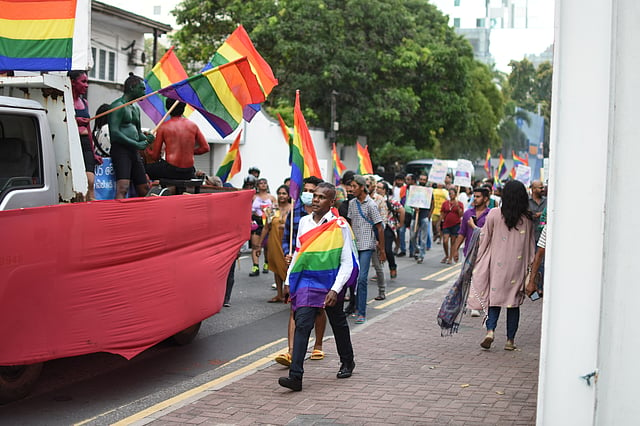
Lecturer and filmmaker, Visakesa Chandrasekeram walks past a truck carrying performers from nonprofit art group Bakeriye Kattiya at the Generation Pride March, held on 5 June 2023. Both the Generation Pride and Equal Ground Pride parades in 2023 received a lot of public backlash. Riyal Riffai
IN 2022, Wickremesinghe as president initiated a series of measures to repress dissent and end the mass protests around the economic crisis that had felled his predecessor, Gotabaya Rajapaksa. One such step was the inclusion of Sections 365 and 365A under emergency regulations designed to grant additional search-and-detention powers to the security forces. In August 2022, the president removed these sections from the emergency regulations after public outcry. That same month, Premnath Dolawatte, a member of parliament, announced his intention to introduce a bill to decriminalise same-sex relationships. “Where did the private member’s bill come from? Where did the first proposal come from? No one is quite sure,” Petersen said.
The first version of the bill presented by Dolawatte removed the reference to “private” from Section 365A, thus proposing to end criminal liability for “unnatural” sex acts in private spaces, but retained 365A’s references to “unnatural sex” and “gross indecency”. The lack of a proper definition and the continued ambiguity in the bill sparked widespread criticism, as it meant the police could continue to arbitrarily discriminate against members of the queer community even if the bill was passed. Activists pointed out that marginalised groups such as nachchis and poor transgender folk often had no access to “private” spaces to meet a partner. “The bill had to be consistent with our calls and what we had advocated for in the last 10-15 years,” Oorloff said.
In a revised bill, presented in March 2023, Dolawatte removed the references to “gross indecency” and “unnatural sex”. The bill was, essentially, set to become a provision against bestiality. The researcher Pasan Jayasinghe praised the bill as being “simple” but noted that it was a private member’s bill, involving a more time-intensive and convoluted process for enactment than a government bill. A government bill only had to be presented to the cabinet for approval. “Private member’s bills have to pass through the minister of justice, a number of parliamentary committees and then have to be voted on by the parliament,” he said.
Dolawatte presented the proposed bill to the attorney general and then prepared to present it in parliament. Citizens had time to file petitions to question the constitutionality of the bill. Three petitioners – a member of the military, a journalist and a politician attached to the Rajapaksas’ Sri Lanka Podujana Peramuna (SLPP) – complained that decriminalisation could lead to child abuse, increase the spread of HIV and act as a disincentive for joining the army. The bill was also an insult to Sinhala Buddhist culture, they declared. If the bill was to pass, they demanded a super-majority in parliament or a referendum. In quick succession, 30 individuals and two civil-society organisations presented 14 intervening petitions to the Supreme Court.
Oorloff, who works at the Family Planning Association of Sri Lanka, filed one of the intervening petitions, countering the claim that decriminalisation would contribute to the spread of HIV. Without decriminalisation, his petition stated, HIV could actually spread more, because people would be less likely to seek medical services to treat it for fear of being branded as “second class citizens”. “I felt my humanity drained out of me,” Oorloff said later about his experience listening to the petitioners’ accusations.
In May 2023, the Supreme Court ruled in favour of the LGBTIQA+ community and called the petitions “baseless”, “excessive” and “absurd”. The court made clear that the bill only needed a simple majority in parliament to pass.
Before 2023, Sri Lanka had seen several failed attempts at decriminalisation. In 1995, a proposed decriminalisation bill backfired. G L Peiris, a member of parliament from the Sri Lanka People’s Freedom Alliance, claimed that Section 365 applied only to men and so pushed for the inclusion of the term “woman” in the bill. During a process of constitutional reforms in 2016, spearheaded by the Yahapalanaya government under Maithripala Sirisena, several organisations, including the Human Rights Commission of Sri Lanka, proposed amending Article 12 of Sri Lanka’s constitution, which deals with discrimination, to encompass sexual identities. This, however, never came to fruition.
Apart from the NPP’s pledge to decriminalise same-sex relationships, Gotabaya Rajapaksa raised the issue of decriminalisation on social media in 2021, while he was president. In 2023, Ali Sabry, during his tenure as the minister of foreign affairs, announced that the government would be supporting a decriminalisation bill. But none of these promises have materialised either.
Many members of the political opposition, primarily those from the United National Party, have been criticised or insulted over their presumed or stated sexuality. In 2018, Sirisena called Wickremesinghe, who was then the prime minister, a samanalaya, or butterfly – a common slur for queer people in the Sinhala language. “The SLPP campaign in 2019 ran on an ethno-nationalistic, militaristic and queerphobic platform,” Thiyagaraja told me. Dolawatte, the parliament member responsible for the latest decriminalisation bill, is a member of the SLPP, and entered parliament on a nominated seat in 2020. This raised the question: could a representative of a conservative party spearhead and actualise a bill that could liberate the very constituency his party discriminated against in their election campaign?
There have been major recent shifts in the legal status of same-sex relationships elsewhere in Southasia. India decriminalised homosexuality in 2018 and Nepal legalised same-sex marriage in 2023, having itself decriminalised homosexuality in 2007. In 2023, the Supreme Court of India, ruling on the legality of same-sex marriage, left the question for parliament or state assemblies to legislate on. From a distance, the proposed bill in Sri Lanka appeared to be part of a regional shift in favour of the LGBTIQA+ community, even as local queer activists remained sceptical of its chances.
Both the Generation Pride and Equal Ground Pride parades in 2023 received a lot of public backlash. Visakesa Chandrasekaram, a lawyer and lecturer at the University of Colombo, voiced his doubts about the intent behind the bill. “Is this a bid to make a third enemy to protect a failed government?” Chandrasekaram asked. This “third enemy” would join the ranks of Sri Lanka’s Tamil and Muslim minorities, both of which have been demonised and exploited by the country’s politicians. Jayasinghe said he believed that the proposed reforms were a ploy aimed at appealing to the international community at a time when Sri Lanka needed to appear progressive and ease itself out of the economic crisis. “Decriminalisation could be taken to various international forums as proof of progress,” he said.
Jayasinghe cautioned, “The momentum [from] the Supreme Court ruling is not likely to last forever.” In fact, two years later, it has completely fizzled out after a hectic election season and a change of government.
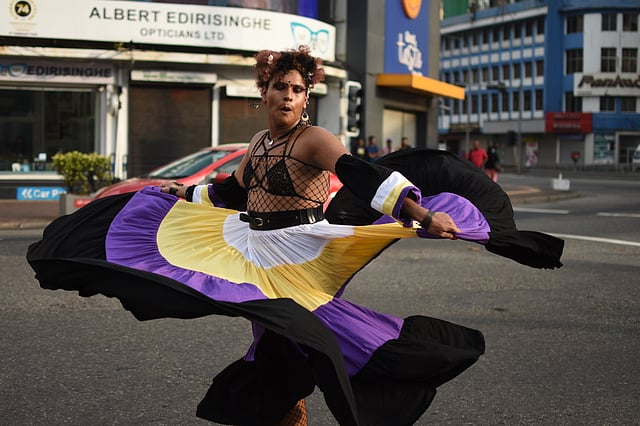
Activist Navodya Bennett dances near the Liberty Roundabout during the Generation Pride March. Bennett is a young and vocal activist for LGBTIQA+ rights.Riyal Riffai
THE BID TO DECRIMINALISE same-sex relations should be seen in the context of a number of proposed reforms regarding Sri Lankans’ intimate lives. These include proposals to decriminalise abortion and to reform the Muslim Marriage and Divorce Act, which has been used to oppress Muslim women and minors. Separately, a Gender Equality Bill proposed in 2023 and aimed at combating gender-based discrimination faced resistance from the Supreme Court, which ruled that it was inconsistent with Article 12 of Sri Lanka’s constitution, which guarantees the right to equality. Opponents of the bill stated that it could pave the path to same-sex marriages, which some petitioners felt did not fit with Sri Lankan culture.
Even if decriminalisation is achieved, the status-quo will certainly not be disrupted by decriminalisation alone, nor will Sri Lankan society be radically transformed by just this step.
In Sri Lanka, queer people continue to be dehumanised and treated as outsiders for their sexual identity. A transgender man working in a Free Trade Zone, who asked to remain anonymous, told me of how he overheard a series of remarks made about other transgender men at the site. He did not speak up for fear for his personal safety, and continues to keep his identity a secret. “I wonder if they stare at us to threaten us,” he said. “When I am in the toilet, I study their faces in the mirror as I wash my hands, to see if they are suspicious about my identity.”
A 2012 report from EQUAL GROUND noted a correlation between the visibility of someone’s sexuality and/or gender and their vulnerability to discrimination. Many LGBTIQA+ people face homelessness if they come out. They are also subjected to physical violence from family, extended family and healthcare providers. In January 2023, local media reported that a lesbian was imprisoned inside her home and tortured for her sexuality. A 2021 report by the Asia Pacific Transgender Network cited that many Sri Lankan families push their children into conversion therapy programmes run by clergy, supernatural practitioners and medical personnel of both Ayurvedic and Western traditions.
Members of the queer community are also routinely subjected to forced anal or vaginal inspections by medical personnel. A 2014 report from Equal Ground revealed that medical personnel had also maliciously circulated information about queer patients. There is also limited understanding across the healthcare sector of LGBTIQA+ healthcare, including gender affirming procedures such as transitioning and hormone-replacement therapy. While members of the transgender community can request a Gender Recognition Certificate as of 2016, they must follow a strict bureaucratic process, which includes receiving a consultant psychiatrist’s letter affirming their gender status. As a result, many people remain unable to open bank accounts, vote or travel overseas under their chosen gender identities.
Members of the LGBTIQA+ community also face social policing in schools, where binary notions of masculinity and femininity are rigidly enforced, resulting in students being socially isolated for being queer. As the researcher and activist Damith Chandimal pointed out, if students engage in consensual queer romantic relationships, “the teachers act as if the world is about to end. The student’s families are contacted, they are ‘outed’ and they are asked to leave school.” Such policing continues in the workplace. An EQUAL GROUND report published in 2021 revealed that 42 percent of the respondents kept their queer identity secret and 50 percent believed that coming out could lead to more discrimination. Respondents also reported experiencing verbal and sexual harassment because of their identity and/or sexuality.
In prisons, LGBTIQA+ people are subject to segregation into male-only and female-only spaces. “Hair is an important part of some transgender people’s identity,” Damith told me. When their hair is cut, as it often is in prison, “it is a massive problem for their mental health.” All prison inmates are vulnerable to mental, physical and sexual violence. Sri Lankan Prison statistics record that six people were imprisoned under Section 365 in 2022, while 14 people were imprisoned under Section 365A in the same year.
“Decriminalisation is very important but there are other laws which make us vulnerable,” Angel Queentus, the founder of the Jaffna Transgender Network, told me. The transgender community is threatened by Section 399, which criminalises “cheating by impersonation”. The majority of the LGBTIQA+ community faces discrimination under the Vagrants Ordinance 1841, which applies to anyone who behaves in a “riotous, disorderly” or “indecent” manner. Transgender people, non-binary people and the nachchis arrested under this act are advised by their counsels to admit to the charges against them, even if they are innocent, and pay the small fine this entails. But then, they have a criminal record that tails them for life, impacting their access to housing, education and employment, particularly if they want to migrate for work overseas.
A 2023 report by the Sri Lanka chapter of Sex Workers and Allies South Asia, a coalition that operates in India, Bangladesh, Nepal and Sri Lanka, recommended the repeal of the law because its ambiguous application “has made it a weapon in the hands of the legal community and law enforcement who use it to exploit and unleash legally sanctioned violence upon already severely oppressed sex workers.” So even if Sections 365 and 365A are undone, the criminalisation of the community will continue under other laws.
Decriminalisation also will not reduce or address online violence. A 2021 study by the researchers Sachini Perera and Zainab Ibrahim found that 62 percent of the respondents had experienced abusive comments on social media and 40 percent had been subjected to the non-consensual circulation of private information.
A further limitation of decriminalisation is its limited scope. “Decriminalisation homogenises the entire LGBTIQA+ population,” Thiyagaraja explained. Since Sri Lanka’s independence, Tamil people have faced institutionalised racism when it comes to language, education, employment and more. Tamils have also been subjected to terrible crimes during the Sri Lankan Civil War and the continued militarisation of the country’s north and east, among them enforced disappearances, the occupation and colonisation of private lands and arbitrary arrests under the Prevention of Terrorism Act. “Many people’s identities are confined to their houses,” Sathurshan Kannan, a 27-year-old Tamil university student, told me. “Within my community, I am burdened by the caste system, cultural barriers and conservative influences.” He is not fully out in his community and is very cautious in familial and educational environments.
Similarly, Malaiyaha Tamils have been oppressed since their disenfranchisement by the state in 1948. Despite recent reforms, they have lacked access to quality healthcare and education and still often have no rights to the land they live and labour on. There are a number of LGBTIQA+ people within the community, but the scarcity of information accessible to them increases their vulnerability. “Several people have committed suicide,” Subramaniam Sugumar, who co-founded Aruvi as a collective for queer Malaiyaha Tamils in 2021, told me. In Nuwara Eliya, as across Sri Lanka, many cisgendered men condemn the LGBTIQA+ community in public but covertly pursue relationships with them.
Muslims have been subjected to communal violence such as riots in 2018, as well as Islamophobia after the 2019 Easter Sunday bombings and then during the pandemic, when the state denied them their burial rites. Many queer Muslim people find it hard to reconcile their various identities as Sri Lankan, Muslim and LGBTIQA+.
Imaad Majeed, a 33-year-old non-binary artist and activist from the Muslim community, told me that their faith oscillates like a pendulum. “The Islamic identity which I was raised with was at odds with the contemporary identity I had,” they said. “I have become comfortable with Islam by meeting other people, learning about other queer movements and reading historical anecdotes of queerness.” Their journey to accepting queerness as a positive force only happened in the last decade.
The Batticaloa-based activist Shydhah Zaara said she believes that decriminalisation will make conversations more intersectional. “Decriminalisation can help the Muslim community understand that there are LGBTIQA+ members within the community,” she told me.
While many people perceive the LGBTIQA+ movement as being separate from class, caste, ethnicity and race-based issues, the reality is that queer people encompass a variety of identities. The liberation of LGBTIQA+ people is linked to the liberation of all oppressed persons in the country.
Over the next decade, the LGBTIQA+ community have an array of issues related to the intimate life of the polity to champion. Gender equality. The loss of the communal, extended family and the rise of the private, nuclear family. The need for care structures and social protection for the most vulnerable people in the country, namely children, disabled persons and the elderly.
THE SUPREME COURT DECISION on the private member’s bill came in May 2023, just before Pride Month in June. A loose collective of individuals calling themselves Generation Pride planned a Pride march in Colombo, following on from the country’s first ever such march in 2022. On 4 June, a number of community members, trade unionists and activists took to the streets. Attendees held up placards about repealing Section 365 and Section 365A, and also advocated for reduced militarisation in the north and east and justice for war-time crimes.
Members of Sri Lanka’s LGBTIQA+ community have long been vocal in speaking out against injustice and discrimination. This occurred in the constitutional crisis in 2019, during the protests that ousted the Rajapaksas in 2022 and during trade unions protests about “EPF theft” (referring to the Employees Provident Fund, a mandatory defined contribution retirement scheme for private and semi-government sector employees) under the guise of domestic debt restructuring in 2023. During the 2024 Generation Pride march, participants held up posters demanding labour rights, access to abortion and chanted in solidarity with Palestine. With the IMF-imposed austerity and increasing inequality, this bloc of citizens have an important role to play.
source:https://www.himalmag.com